What are the food, accommodation, and transport options on the Langtang Valley Trek?
Accommodation, food, and transport shape your daily experience on the trail more than most trekkers expect. Here's what to expect on this 10-day Langtang Valley trek:
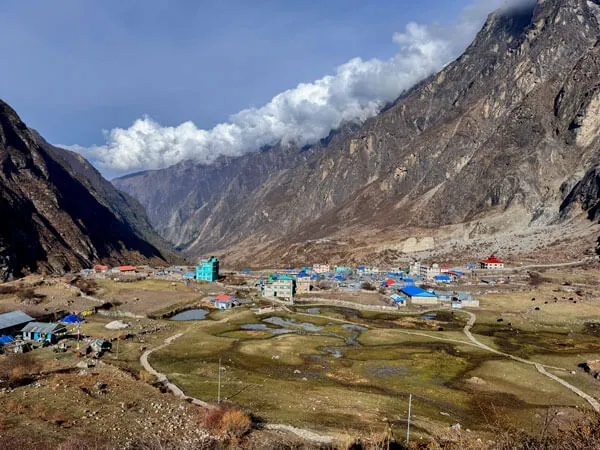
Accommodation: You stay in a hotel in Kathmandu on your arrival and return nights- comfortable, central, with private bathrooms. Syabrubesi has proper hotels with more amenities than the trail. On the trek itself, you sleep in tea houses: simple wooden lodges with twin-share rooms, basic bedding, and shared bathrooms. Above 3,500m, from Kyanjin Gompa upward, attached bathrooms are rare and hot water is usually solar-heated or bucket-based. Bring your own sleeping bag liner for extra warmth and hygiene.
Food: The AP (full board) plan covers breakfast, lunch, and dinner from Day 2 through Day 8. Tea house menus on the lower trail are more varied than most trekkers expect: dal bhat, momos, thukpa, noodle soup, eggs in multiple forms, pasta, Tibetan bread, porridge, and pancakes. Above 3,500m, menus shrink, and prices rise. Dal bhat is always the best value and usually the most reliable. Budget around USD 10–15 per day for anything outside the included plan: drinks, snacks, desserts, or extra meals. Vegetables become harder to source above Langtang Village; don't expect fresh salads at Kyanjin Gompa.
Drinking water: Boiled water is available at all tea houses and is safer than untreated tap water. Bring a 1-litre reusable bottle and water purification tablets as backup. Avoid buying single-use plastic water bottles on the trail; it creates waste that has no easy disposal above the road head.
Transport from Kathmandu to Syabrubesi runs in a private sharing jeep, a 4WD vehicle shared with other passengers from our group. The journey is 7 to 8 hours. The road is paved for most of the route but rough on the final section. All airport transfers use a private vehicle, so you won't share with strangers on arrival or departure day.
What permits do you need for the Langtang Valley Trek in 2026/2027?
Langtang is one of the simpler permit situations in Nepal. No restricted area permit, no special access requirements. You need two permits to enter the Langtang region. Both are arranged by Madcap Adventure in Kathmandu before you leave, so you don't have to queue for them yourself.
Langtang National Park Entry Permit:
- Foreign nationals: NPR 3,000 per person. SAARC nationals: NPR 1,500 per person. Nepalese trekkers: NPR 100 per person.
- No seasonal variation, flat rate year-round
- Can be obtained at the Langtang National Park Management Authority in Kathmandu, or at entry checkpoints in Dhunche and Syabrubesi if not purchased in advance. TIMS Card (Trekkers' Information Management System)
- USD 10 per person for trekkers booked through a registered agency. USD 20 for individual/independent trekkers.
- Supports safety monitoring and trekker tracking throughout the route
- Must be obtained through a trekking agency or at the Nepal Tourism Board / TAAN office in Kathmandu
Note: Permit fees are reviewed periodically. Confirm current rates with us before booking.
When is the best time to do the Langtang Valley Trek?
Langtang is open year-round, but conditions vary sharply by season. Here's what each window actually delivers.
Autumn: October to November (Best overall). This is the most popular season for good reason. Skies are clear after the monsoon, trail conditions are stable, mountain views are sharp, and temperatures are comfortable during the day. Nights above 3,500m get cold. Expect 0°C to -5°C at Kyanjin Gompa in November. Book accommodation in advance during October, as popular tea houses fill up.
Spring: March to May (Strong second choice). Warmer than autumn, with rhododendrons flowering along the entire lower valley. Visibility is generally good, though some haze builds by May. A solid choice for anyone who can't do autumn. The trail is busy but slightly less crowded than October.
Winter: December to February (Possible, not ideal for first-timers). The trail stays open, but nights are cold. Temperatures at Kyanjin Gompa can drop to -10°C or lower. Fewer trekkers means quieter tea houses, and some lower your costs by negotiating room rates. If you're experienced with cold-weather camping and have the right gear, winter is doable. For first-timers, it's not the recommended entry point.
Monsoon: June to August. Monsoon is trekkable, and it typically costs less since fewer trekkers are on the trail during this period. Expect heavy rainfall, a higher chance of trail landslides, leeches on the lower sections, and limited mountain views. The Langtang Valley sees fewer visitors during monsoon than some other regions, which means quieter tea houses and more room for negotiation on rates. Trekkers comfortable with wet conditions and reduced visibility can complete the route safely with the right gear.
How difficult is the Langtang Valley Trek?
Langtang Valley trek sits in the moderate difficulty range. It doesn't require technical climbing, glacier travel, or prior high-altitude experience, but it's still not a stroll in the streets of LA.
- Daily walking: 5 to 8 hours per day, depending on the day
- Total trekking distance: approximately 55-60 km round trip (around 71 km including the Tsergo Ri summit day)
- Maximum altitude gain in a single day: approximately 1,045m (Day 4, Lama Hotel to Mundu)
- Highest sleeping altitude: 3,870m (Kyanjin Gompa)
- Highest point reached: 5,033m (Tsergo Ri — summit day only)
Who handles it well: Anyone who is reasonably active, regularly walks, cycles, swims, gym, and can sustain 5 to 7 hours of uphill movement over multiple consecutive days. You don't need to have trekked before, but you need to be comfortable on uneven terrain and honest about your fitness level.
Who should train before coming: If you're sedentary at home and haven't done sustained physical activity in months, do 6 to 8 weeks of cardio training before the trek; long walks with a loaded daypack work well. Arriving undertrained affects your enjoyment and your safety at altitude.
How it compares:
- Easier than: Manaslu Circuit, Everest Three Passes, Annapurna Circuit with Thorong La
- Similar to: Annapurna Base Camp, Ghorepani Poon Hill (lower altitude)
- Harder than: Poon Hill alone, Nagarkot day hike, lower Langtang day treks
Common mistakes to avoid on the Langtang Valley trek
1. Not withdrawing enough cash in Kathmandu
There are no ATMs after Syabrubesi. None. If you run short on the trail, for hot showers, charging fees, extra food, emergencies, you're stuck. Withdraw enough rupees in Kathmandu to cover 7 to 8 days of personal spending at USD 15–20 per day equivalent.
2. Skipping the Tsergo Ri hike on acclimatization day
Some trekkers feel tired after Days 3 to 5 and decide to rest instead of climbing. This is a mistake; the Tsergo Ri summit is the highlight of the entire route. If you're feeling OK (no AMS symptoms), push yourself. You won't get a second chance without extending your trip.
3. Underestimating Day 4's altitude gain
The jump from Lama Hotel (2,380m) to Mundu (3,545m) is the biggest single-day gain on the trek, over 1,045m. Trekkers who push too fast on this day often feel altitude effects at Kyanjin Gompa. Walk slowly, eat properly at lunch, and don't compete with other trekkers.
4. Not bringing a power bank
Charging your phone or camera at tea houses costs money (NPR 100–200 per charge) and isn't always reliable above 3,500m. A 20,000 mAh power bank keeps your devices topped up for the whole trip without depending on solar availability at altitude.
5. Buying snacks on the trail instead of in Kathmandu
Snack prices on the trail are 3 to 5 times Kathmandu prices, especially above Langtang Village. Buy your energy bars, nuts, dried fruit, and electrolyte tablets in Thamel before you leave. It's a small saving that adds up over 7 days.
6. Booking without checking current permit rules
Permit requirements and fees do change in Nepal. TIMS rules have shifted in recent years. Check the current status before booking, or ask us directly and we'll give you the most up-to-date information.
Why is travel insurance non-negotiable on the Langtang Valley trek?
We don't allow trekkers to join our Langtang package without travel insurance, and if you read why, you'll understand the policy isn't bureaucratic; it's practical.
Helicopter evacuations from the Langtang region cost USD 3,000 to 6,000 or more depending on pickup location and conditions. That's a bill you cannot afford to face uninsured at altitude, when decisions need to be made fast.
Your insurance must cover:
- Helicopter evacuation from altitudes of at least 5,000m
- Emergency medical treatment and hospitalisation in Nepal
- Trip cancellation or interruption due to medical reasons
- 24/7 emergency assistance hotline (not just email; you need a phone number that works)
- Repatriation to your home country if required
Standard travel insurance without an adventure sports or trekking extension often doesn't cover helicopter evacuation; check your policy before departure, not at Kyanjin Gompa when you need it.
How safe is the Langtang Valley Trek & how do you handle the altitude?
Langtang Valley is one of the safer trekking routes in Nepal. But altitude is real, and pretending otherwise doesn't help anyone. Above 3,000m, your body is working harder than usual. Above 3,500m, some trekkers will feel the effects of altitude like headache, fatigue, reduced appetite, and disrupted sleep. These are normal early signs. They become dangerous when ignored.
Acute Mountain Sickness (AMS) early signs:
- Persistent headache that doesn't ease with paracetamol
- Nausea or vomiting
- Dizziness or loss of coordination
- Fatigue beyond what the day's effort should cause
- Difficulty sleeping more than usual
What your guide does: Your licensed guide monitors the group daily. They're trained to spot AMS early and will not push an unwell trekker to higher altitude. The rule is: if symptoms worsen, descend. Descending even 300 to 500m usually brings rapid relief.
Why the acclimatization day matters: The itinerary is built with acclimatization in mind. Two nights at Kyanjin Gompa, a gradual ascent profile before attempting Tsergo Ri, allows your body time to produce more red blood cells and adjust to reduced oxygen. Your guide carries a pulse oximeter and checks oxygen saturation daily above 3,500m. If your numbers drop and don't recover, descent is the only correct answer, and we don't negotiate on that.
Evacuation availability: Helicopter evacuation is possible from the Langtang region, though weather and trail conditions can delay it. Your guide carries the emergency contact numbers. This is why insurance covering helicopter evacuation to 5,000m+ is mandatory.
How to prepare for the Langtang Valley Trek in Nepal?
- Withdraw cash in Kathmandu enough for 8 days. NPR 15,000 to 25,000 is a reasonable range for personal spending (hot showers, charging, extra food, tips). There are no ATMs after Syabrubesi.
- Download offline maps before leaving Kathmandu. Maps.me and OsmAnd both have Langtang Valley loaded. Download the offline pack before you leave; mobile data is unreliable above Syabrubesi and non-existent above Lama Hotel.
- Buy snacks in Thamel, not on the trail. Stock up on energy bars, nuts, electrolyte sachets in Kathmandu at one-third of trail prices.
- Carry a 20,000 mAh power bank. Charging at tea houses costs money and isn't always available at altitude. One good power bank keeps your phone, camera, and headlamp battery topped up for the full trek.
- Book early for autumn season. Popular tea houses at Kyanjin Gompa can be full in October and November. Booking your package 3 to 6 months out also opens up early bird pricing.
- Layer, don't just bring one heavy jacket. Temperature changes fast between walking pace and standing at altitude. A moisture-wicking base layer, mid-layer fleece, and a wind-proof outer shell beats a single big puffer every time.
- Confirm road conditions before your drive to Syabrubesi. The Syabrubesi road is subject to landslides, especially in monsoon season or after heavy rain. Your guide will check conditions the evening before departure; if there's a delay risk, we'll adjust.
- Get a Nepali SIM card on arrival. Ncell and Nepal Telecom both have reasonable data plans. You'll have signals in Kathmandu, Syabrubesi, and intermittently on the lower trail. It's useful for WhatsApp, offline map downloads, and emergencies.
What early bird discounts are available for the Langtang Valley Trek in 2026?
Booking early on the 10 days Langtang Valley Trek in Nepal isn't just about saving money, though it does that too. It's about locking in your preferred dates before the autumn and spring departure slots fill up, which they do faster than most people expect.
How the early bird pricing works
- Book 6+ months in advance: save up to 15% off the standard package price
- Book 3–6 months in advance: save up to 10% off the standard package price
- 2027 Season Pre-booking Offer: Lock in 2026 pricing for your 2027 Langtang Valley trek by booking before December 31, 2026. A 20% deposit confirms your dates.
- Group bookings of 4 or more: additional group discount applies on top of any early bird rate; contact us for exact figures
- Free Nepal SIM card on arrival: Pre-loaded with data so you're connected from Day 1
- Locked-in pricing guarantee: No price increases after your deposit is paid, even if costs rise before departure
- Private group departure option: Book early and we can guarantee a private departure for your group. No shared departures with strangers
- Extra rest day in Kathmandu: On request, we can add a Kathmandu sightseeing day before the trek at a discounted rate for early bookers
What early booking protects you from
- Permit fees, guide wages, and jeep costs in Nepal are not fixed year to year. When we confirm a booking, we lock in your price at the rate current on that date. Trekkers who book late absorb any increases that happen between now and their departure. Booking early is the only way to guarantee the price you've been quoted.
What's required to secure the early bird rate
- A 20% deposit confirms your booking and locks in your early bird price. The remaining balance is due 45 days before departure. If you need to postpone after booking, the early bird rate transfers to your new date as long as you give us 60 days' notice.
What is the cancellation and refund policy for your Langtang Valley Trek?
Booking a trek months in advance always carries some uncertainty. Plans change, emergencies happen, and sometimes things outside your control get in the way. Here's exactly how our cancellation and refund policy works, no fine print surprises.
- Full refund: Cancel 60 or more days before your departure date, and you get everything back, no questions asked.
- Partial refund. Cancel 30–59 days before departure, and we refund 50% of the package cost. By this point we've already locked in permits and made staff commitments on your behalf, so we can't return the full amount.
- No refund: Cancellations made less than 30 days before departure are non-refundable. This is exactly why we ask every trekker to carry travel insurance with trip cancellation and interruption cover before they pay their deposit.
- Substitute trekker: Can't make it but know someone who can? You're welcome to send a friend or family member in your place at no rebooking fee, provided you notify us at least 30 days before departure, and they meet the same health and permit requirements.
- Early descent: If altitude sickness, injury, or a personal emergency means you need to leave the trail early, your guide handles all logistics to get you out safely. Unused trek days are not refunded, which is another reason solid travel insurance with curtailment cover is non-negotiable on a trek that reaches 5,033m.
- Force majeure: If your trek is cancelled due to a natural disaster, government restriction, road closure, or any event outside our control, we'll offer a full credit toward a future departure within 24 months, or a refund minus any costs already paid out on your behalf.
- Date changes: Need to shift to a different departure in the same season? Let us know at least 45 days before your scheduled start, and we'll move your booking with no change fee.
- Deposit to future trek: If you cancel within 30 days but want to rebook for a later date, your deposit carries forward as credit toward any Madcap Adventure trek within 12 months.
How to Cancel?
Send your cancellation request in writing to our main booking email. Include your booking reference, your full name, and your scheduled departure date. We'll confirm receipt within 24 hours and process any applicable refund within 7 to 10 working days.
How to book your Langtang Valley Trek with Madcap Adventure
Step 1: Tell us your dates and group size. Send us a message via the enquiry form, WhatsApp, or email with your preferred dates, group size, and any questions. We'll confirm availability and send a clear quote within 24 hours.
Step 2: Review your quote and itinerary. We send a full breakdown of what's included, what's not, and what your total cost is. No hidden charges. If you want to customize the itinerary or add extras, now's the time.
Step 3: Confirm your booking with a deposit of 20%locks in your dates and pricing. We'll send a booking confirmation and a pre-departure info pack covering gear, permits, visa, and flight recommendations.
Step 4: Prepare for your trek. We send a detailed pre-departure guide covering what to pack, how to train, what to buy in Kathmandu, and what to expect on the trail. We're available by WhatsApp for any questions before you fly.
Step 5: Arrive and trek. We pick you up from the airport. Everything else is handled from there.
No pressure to book immediately. If you're still comparing options, we're happy to answer specific questions or send you a detailed itinerary breakdown to compare against other operators.