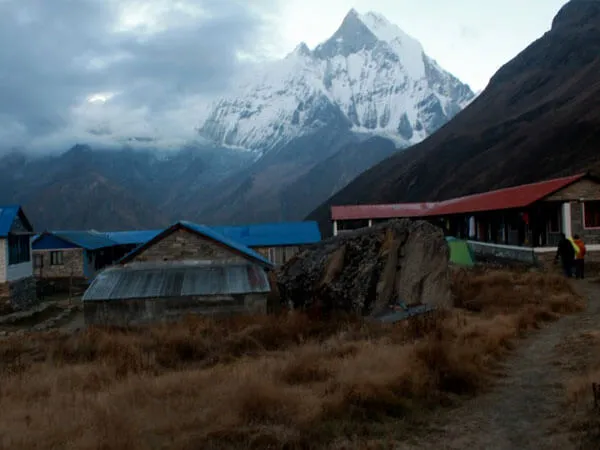
Short Annapurna Base Camp Trek

6 reviews in TripAdvisor
10 reviews in Google
Trip Facts
Duration
7 Days
Difficulty Level
Moderate (Grade B)
Maximum Altitude
4130m
Region
Annapurna Region
Starts
Pokhara
Ends
Pokhara
Accommodation
Hotel and Teahouse
Meals
Breakfast, Lunch and Dinner
Group Size
1-12
Activities
Trekking
Season
Spring and Autumn

The 7-day Annapurna Base Camp trek is the short version of the Annapurna Sanctuary route, built for trekkers who want to stand inside the ring of peaks at Annapurna Base Camp (4,130m) without taking the 10 to 12 days the standard itinerary needs. You start and end in Pokhara, sleep in tea houses every night, and cover the route over six trekking days bookended by a jeep ride on each end.

This package suits trekkers with moderate fitness who can handle two days of sustained stone steps. It is not the right pick if you want to avoid altitude entirely or if you have fewer than seven

Trip Overview

The 7-day Short Annapurna Base Camp trek covers the essential route from Pokhara to the foot of the Annapurna Massif and back in one week. You start with a jeep ride to Ghandruk (2,012m), one of the largest Gurung villages in Nepal, and spend five days moving north through dense rhododendron forest, the narrow Modi Khola gorge, and a high glacial corridor before standing in the amphitheatre at Annapurna Base Camp (4,130m). The return route ends at Jhinu Danda (1,780m), where natural hot springs sit above the Modi Khola river, before a jeep brings you back to Pokhara on Day 7.

This is not a sightseeing loop. The route climbs over 3,300m from Pokhara to ABC across four days, with daily walking ranging from 5 to 8 hours on steep, forested, and at times rocky terrain. The 7-day format moves faster than the standard 10 to 12-day version, which means no built-in rest days above 3,000m. That is the main trade-off: you reach the same destination, but with less margin if weather delays a day or altitude slows you down above Deurali.

What the shorter format keeps is everything that defines this route. The stone lanes of Ghandruk on Day 1. The forest climbs through Sinuwa and the bamboo sections below Deurali, which run through full rhododendron bloom in March and April. The close, direct view of Machhapuchhre's twin summit from MBC (3,700m), a mountain that has never been climbed and looks from this angle like it never could be. And the ABC amphitheatre itself, surrounded on three sides by peaks above 6,000m, is best seen before 8 am, before clouds build from the valley below.

The route runs entirely within the Annapurna Conservation Area and requires an ACAP permit (approx. USD 30 for foreign nationals) and a TIMS Card. A Nepal Government licensed guide accompanies all Madcap Adventure treks on this route. Tea house accommodation is available throughout, from the solid lodges in Ghandruk and Chhomrong to the colder, more basic rooms at Deurali and ABC.

Package cost starts at USD 685, covering a licensed guide, all meals, shared tea house accommodation, both permits, and jeep transfers from Pokhara. The last ATM on the route is in Chhomrong on Day 2. There are no card payment facilities above that point.

If you have one week, reasonable fitness, and some prior trekking experience, this route gets you to one of the most enclosed and visually complete high-altitude settings in Nepal without needing two weeks on the trail. If this is your first multi-day trek, the Ghorepani Poon Hill Trek is the right starting point. Complete that, and ABC becomes the logical next step.

Who the 7-Day Annapurna Base Camp Trek Is For (and Who Should Skip It)

This suits you if:

  • You have moderate fitness and can walk 5 to 8 hours a day on uneven stone trails.
  • You have 7 full days available, including arrival and departure from Pokhara.
  • You want to reach a genuine high-altitude viewpoint without a multi-day approach march or a high pass crossing.
  • You are comfortable with tea house accommodation and shared bathrooms at altitude.
  • You want mountain views of Annapurna I, Machhapuchhre, Hiunchuli, and Gangapurna without the cost or permit complexity of a restricted area trek.

Skip this if:

  • You want to avoid altitude above 3,000m. Look at the Ghandruk village trek or a Poon Hill Trek instead, both of which stay well below the altitude sickness risk zone.

  • Knee or joint problems make sustained stone steps difficult. The Sinuwa approach and the Bamboo descent are stair-heavy, and there is no shortcut around them.
  • You want fewer trekkers on the trail. The Annapurna Sanctuary is one of the most travelled routes in Nepal, especially during October and November. The Mardi Himal Trek covers similar terrain with far less foot traffic.
  • You only have 3 to 4 days. Consider the Poon Hill Trek, which fits a shorter window and stays under 3,300m.
  • You are looking for a remote or off-the-beaten-path experience. Then, our short 7-day Manaslu Circuit Trek will be perfect for you.
  • You want a lower-altitude cultural walk. The Annapurna Panorama Trek or Ghandruk Loop is a better fit.

Annapurna Base Camp Trek Highlights

  • Two base camps in one itinerary. Most routes have one destination. This one takes you through Machhapuchhre Base Camp (3,700m) on the way to Annapurna Base Camp (4,130m). Two completely different landscapes, one itinerary. 
  • A 360-degree mountain amphitheatre. Reach Annapurna Base Camp (4,130m) inside a bowl of peaks that includes Annapurna I (8,091m) and Machhapuchhre (6,993m), in a 7-day round trip from Pokhara.
  • Sleep inside the Annapurna Sanctuary itself rather than viewing it on a single long day hike.
  • An 8,000m peak's base camp without technical skills. Annapurna I is the world's 10th highest mountain and the first 8,000m peak ever summited. Getting to its base camp requires fitness and determination, not ropes or crampons. 
  • Walk through Ghandruk on day one, a Gurung village with stone-paved lanes and slate-roofed houses built into the hillside.
  • Climb the stone staircase sections between Kimrong Khola and Chhomrong on day two, a stretch every past ABC trekker mentions first.
  • Pass Machhapuchhre Base Camp before the final approach to Annapurna Base Camp on day four.
  • Soak in the natural hot springs at Jhinu Danda on the way down, a genuine reward for tired knees.
  • Trek inside the Annapurna Conservation Area rather than a restricted area, which keeps the permit process lighter than Manaslu or Upper Mustang.
  • Cover the same sanctuary that the standard itinerary takes 10 to 12 days to complete, in 7.
  • See Annapurna South, Hiunchuli, and Gangapurna at close range, not only Annapurna I.
  • Trek entirely on an established trail with tea house accommodation and three meals a day. No camping gear required.
  • Layered Landscapes. In seven days, you'll pass through five distinct vegetation zones: subtropical forest (800m) to alpine meadow (4,130m).
  • Cultural depth that is not manufactured for tourists. The route passes through Gurung and Magar villages that have existed in these hills for centuries, with their own architecture, food, and daily life. Tourism grew around them, not the other way around. 

Annapurna Base Camp Trek Route Overview

The route starts with a jeep ride from Pokhara (820m) up to Ghandruk (2,012m), a Gurung village that sits on a ridge with a direct line of sight to Annapurna South and Hiunchuli on a clear day. From Ghandruk, the trail drops into the Kimrong Khola valley and climbs back up to Chhomrong, the last large village before the sanctuary proper, then continues to Sinuwa (2,360m).

From Sinuwa, the trail moves through Bamboo and Dovan, both inside dense forest, before opening out near Himalaya and climbing above the tree line to Deurali (3,230m). This is where the terrain changes from forest trail to open valley walking, and where altitude becomes a real factor for the first time.

Day four follows the Modi Khola gorge past Machhapuchhre Base Camp and into the Annapurna Sanctuary itself, ending at Annapurna Base Camp (4,130m). The return route retraces the same trail down to Bamboo, then on to Jhinu Danda (1,780m), where the trek's natural hot springs sit a short walk below the village. From Jhinu Danda, a short walk down to the road head connects to a jeep back to Pokhara.

Why book the 7-Day Annapurna Base Camp Trek with Madcap Adventure?

  • All guides are Nepal Government licensed, not just generally, but specifically certified for the Annapurna Conservation Area.
  • The porter rate is fixed at USD 20 per day and covers up to two trekkers per porter, with no added markup once you book.
  • You get a free Nepal SIM card preloaded with data, handed to you in Pokhara before the trek starts.
  • Pricing locks in once your deposit clears. No surcharge applies even if permit fees or domestic transport costs rise before your departure date.
  • Our Kathmandu office runs support around the clock for the full week you are on the trail, not limited to office hours.
  • Book 6 or more months in advance for up to 15% off, or 3 to 6 months out for up to 10% off. A 2027 pre-booking option locks in 2026 rates if you confirm before December 31, 2026, with a 20% deposit.

Is the 7-day Annapurna Base Camp Trek right for you?

The short answer is yes, if you are reasonably fit and can commit to seven full days of walking. This is not a technical trek. No climbing skills, no crampon experience, and no prior high-altitude exposure are needed. Beginners with solid hiking fitness complete this route every season alongside experienced trekkers doing it for the second or third time.

The 7-day Annapurna Base Camp trek format also makes it one of the most budget-friendly ways to reach a Himalayan base camp in Nepal. Fewer days on trail means lower costs across guide fees, accommodation, and meals, without skipping any section of the route that matters.

Solo trekkers are well catered for on this route. The trail is busy enough that you are never isolated, logistics are straightforward through Madcap Adventure, and a licensed guide is arranged as part of your package. Female solo trekkers can request a female government-licensed guide at the time of booking. Mention it when you send your dates, and we will confirm availability with your quote.

Accommodation ranges from simple teahouse rooms with shared bathrooms at higher elevations to more comfortable lodges with attached bathrooms in lower villages like Ghandruk. You choose what fits your budget and travel style. The route supports both ends without requiring you to commit to one.

If you have seven days, reasonable fitness, and want to stand inside a 360-degree mountain amphitheatre at 4,130m without a restricted area permit or technical preparation, this trek delivers exactly that.

How much does the 7-day Annapurna Base Camp Trek Cost?

The 7-day Annapurna Base Camp Trek with Madcap Adventure starts from USD 685 and goes up to USD 870 per person, depending on group size, services selected, and when you book. The standard package covers your guide, all permits, full-board meals, teahouse accommodation for all 7 nights, and private jeep transfers to and from the trailhead. Here is what moves the price.

  • Group size: Travelling with two or more people brings the per-person cost down. A private solo booking carries a single supplement on accommodation and means guide costs are not shared across the group. Groups of four or more qualify for an additional group discount on top of any early bird rate. Contact Madcap Adventure with your group size when you send your dates, and we include the exact figure in your quote.
  • Porter hire: Porter service is available at USD 20 per day, covering up to two trekkers, with a maximum carry weight of 20 kg. Hiring a porter is optional on this route but makes a considerable difference on the longer walking days, particularly Day 2 and Day 5. If you are travelling solo, the cost is not shared.
  • Accommodation: Teahouse rooms range from basic shared-bathroom rooms at higher elevations like Deurali and Annapurna Base Camp to more comfortable lodges with attached bathrooms in lower villages like Ghandruk and Chhomrong. Upgrading your room type at lower elevations adds to the daily cost but is entirely your choice.
  • Meals: Full-board meals are included in the package price. Personal expenses, including hot drinks, cold drinks, alcoholic beverages, and snacks, are paid directly at each teahouse and are not covered. Budget roughly USD 15 to 20 per day for personal spending on the trail, and carry it all in Nepali rupees from Pokhara.
  • Season: Peak season departures in October to November and March to May tend to carry slightly higher package prices due to demand. Travelling in the shoulder months of December or February is possible and quieter on the trail, though nights at altitude are colder.
  • Transport: Ground transport between Pokhara and the trailhead is included in the package by private shared jeep. If you require a private vehicle upgrade or Kathmandu to Pokhara transport by flight rather than a tourist bus, this is available at an additional cost. 

Booking timing: Madcap Adventure offers an early bird discount structure that directly reduces your per-person cost.

  • Book 6 or more months in advance: up to 15% off the standard package price
  • Book 3 to 6 months in advance: up to 10% off the standard package price
  • 2027 departures: lock in 2026 pricing by booking before December 31, 2026, with a 20% deposit to confirm your dates

Short Annapurna Base Camp Trek Itinerary

Starts
Pokhara
Ends
Pokhara
Day 1

Drive Pokhara to Ghandruk

The road climbs out of Pokhara through Nayapul and Birethati to Kimche before reaching Ghandruk, gaining over a thousand metres in the drive alone. You're already adjusting to altitude before the first step on the trail.

Ghandruk is a Gurung village, large enough to have a small museum and a string of tea houses along the ridge. Arrive before 3 pm, and the museum is worth the half hour.

Mountain views: Annapurna South (7,219m) and Hiunchuli (6,441m) are visible from the upper part of the village on a clear afternoon. Machhapuchhre (6,993m) shows itself further along the ridge.

Max Altitude: 2,012m (6,601ft)
Altitude Gain: 1192m
Duration: 2-3 hours
Distance: Approx. 55km/34.2miles
Meals: Breakfast, Lunch and Dinner
Accommodation: Teahouse
Mode of Transportation: Private sharing Jeep
Day 2

Trek Ghandruk to Sinuwa via Chhomrong

The trail drops into the Kimrong Khola valley, crosses the river, then climbs back up through Chhomrong, the last large village before the sanctuary. From there, a stone staircase drops and climbs again to reach Sinuwa Ridge. The cumulative elevation change is more demanding than the net altitude gain suggests.

Chhomrong is your lunch stop and your last ATM. Carry enough cash for shower fees, charging, and the hot springs at Jhinu Danda on the way back. 

Mountain views: Annapurna South and Hiunchuli stay in view through most of the climb to Chhomrong, then disappear behind the ridge on the final stretch into Sinuwa.

Max Altitude: 2,360m (7,742ft)
Altitude Gain: 350m
Duration: 5-7 hours
Distance: Approx. 13 km / 8 miles
Meals: Breakfast, Lunch and Dinner
Accommodation: Teahouse
Day 3

Trek Sinuwa to Deurali

The trail runs through Bamboo, Dovan, and Himalaya Hotel, all inside dense rhododendron forest, before the tree line breaks near Deurali. In March and early April, the bloom through this stretch is at its best.

Past the Himalaya Hotel, the forest thins and the valley narrows fast. Deurali is usually where trekkers first notice the altitude. Mild headaches here are common. Drink more water than feels necessary and skip the alcohol tonight.

Mountain views: Tree cover limits sightlines for most of the day. Annapurna South opens up above the ridge on the final approach to Deurali on clear afternoons.

Max Altitude: 3,230m (10,597ft)
Altitude Gain: 870m
Duration: 6-7 hours
Distance: Approx. 13 km / 8 miles
Meals: Breakfast, Lunch and Dinner
Accommodation: Teahouse
Day 4

Trek Deurali to Annapurna Base Camp via Machhapuchhre Base Camp

The trail climbs the moraine wall past Machhapuchhre Base Camp before the final push into the Annapurna Sanctuary bowl. MBC is your lunch stop, with Machhapuchhre's south ridge filling the view.

From MBC it's roughly one to two hours of rocky moraine to ABC. If your guide agrees conditions are right, arrive with enough daylight to see the amphitheatre before cloud builds in. Be at the upper viewpoint by 6 am the next morning for the clearest light on Annapurna I's south face.

Mountain views: Annapurna I (8,091m), Annapurna South (7,219m), Hiunchuli (6,441m), Gangapurna (7,454m), and Machhapuchhre (6,993m) ring the base camp bowl on a clear day.

Max Altitude: 4,130m (13,549ft)
Altitude Gain: 900m
Altitude Loss: 430m
Duration: 5-6 hours
Distance: Approx. 15 km / 9.3 miles
Meals: Breakfast, Lunch and Dinner
Accommodation: Teahouse
Day 5

Trek Annapurna Base Camp to Bamboo

A long descent retracing the route through MBC, Deurali, and Himalaya Hotel to Bamboo. The stone sections climbed on Day 3 are harder on the knees coming down. Shorten your stride on the steeper pitches. More trekkers turn an ankle on the way down than on the way up.

Mountain views: The high peaks fall out of sight once you drop below Deurali. The forest closes in for most of the afternoon.

Max Altitude: 2,310m (7,578ft)
Altitude Loss: 1820m
Duration: 6-7 hours
Distance: Approx. 16km/9.9miles
Meals: Breakfast, Lunch and Dinner
Accommodation: Teahouse
Day 6

Trek Bamboo to Jhinu Danda

The trail descends through Sinuwa and Chhomrong, crosses the Modi Khola, then climbs briefly into Jhinu Danda. The staircase down from Chhomrong is long and rough on tired knees this late in the trek.

You pass close to the natural hot springs, a short walk below the village on the river bank. If you reach your tea house by 2 pm, there's time before the evening crowd from other groups. Entry runs around NPR 200 to 300. 

Mountain views: Limited through forest cover most of the day. Hiunchuli is occasionally visible above Chhomrong before the trail drops.

Max Altitude: 1,780m (5,839ft)
Altitude Loss: 530m
Duration: 5-6 hours
Distance: Approx. 10km/6.2miles
Meals: Breakfast, Lunch and Dinner
Accommodation: Teahouse
Day 7

Drive Jhinu Danda to Pokhara

A short walk down to the road head connects to your jeep back to Pokhara. The road follows the Modi Khola valley before joining the main highway west into the city. The package closes with a farewell dinner in Lakeside.

Mountain views: None on the drive. The Annapurna range is behind you by mid-morning.

Max Altitude: 820m (2,690ft)
Altitude Loss: 960m
Duration: 2-3 hours
Distance: Approx. 62km/38.5miles
Meals: Breakfast, Lunch and Dinner
Accommodation: Hotel
Mode of Transportation: Private sharing Jeep

Itinerary Flexibility
This itinerary can be adjusted before departure: add a rest day at Jhinu Danda for the hot springs, or extend with an extra night at Annapurna Base Camp for sunrise views. Tell Madcap Adventure your dates, fitness level, and preferences when you book.

Guide Decisions on Trail
Since this itinerary has no built-in rest day above 3,000m, weather delays or altitude symptoms can affect the schedule. Above Deurali, altitude sickness is something your guide watches for daily. In these situations, your licensed guide can adjust the day's pace or plan as needed. This is standard trail judgment, not a formality.

Are you still confused?
Curabitur at felis non libero suscipit fermentum

Route Map & Altitude Chart

Short Annapurna Base Camp Trek
StartMid DaysEnd

Date & Availability

Select Departure Dates
Oct 2026
Nov 2026
Feb 2027
Mar 2027
Apr 2027
May 2027
Sep 2027
Oct 2027
Nov 2027
Feb 2028
Mar 2028
Apr 2028
May 2028
Sep 2028
Oct 2028
Nov 2028
Start Date
Oct 09, 2026
End Date
Oct 15, 2026
Status
Guaranteed
Start Date
Oct 12, 2026
End Date
Oct 18, 2026
Status
Guaranteed
Start Date
Oct 16, 2026
End Date
Oct 22, 2026
Status
Guaranteed
Start Date
Oct 19, 2026
End Date
Oct 25, 2026
Status
Guaranteed
Start Date
Oct 23, 2026
End Date
Oct 29, 2026
Status
Guaranteed
Start Date
Oct 26, 2026
End Date
Nov 01, 2026
Status
Guaranteed
Start Date
Oct 30, 2026
End Date
Nov 05, 2026
Status
Guaranteed

Group departures need a minimum of 2 trekkers to run as scheduled. Solo trekkers can join as a private departure at an adjusted rate. Maximum group size is 12. A 20% deposit secures your seat and locks in the quoted price, with no increases after booking. Full balance is due before departure. Prefer a different date? Madcap Adventure arranges custom departures year-round.

Add-Ons & Options

Porter
Porter service is available at USD 20 per day, covering up to two trekkers, with a maximum carry weight of 20 kg.
US$130
per 1

Equipment List

The climate in the Himalayas changes rapidly, so we have to pack the perfect and usable equipment. The right packing list will make the trip more enjoyable. Packing unnecessary trekking equipment will also increase your budget.

You will need proper warm clothing during the trek. We provide a duffel bag to pack your trekking equipment. You will get it during the pre-trip meeting at our office or hotel. If you need any equipment (Sleeping bag (-10, Down Jacket, and more), you can rent it from the trekking shop in Kathmandu at an extra cost. A sleeping bag costs USD 50, and a down jacket costs USD 40 to use in the mountains. We arrange all gear and logistics in Kathmandu prior to departure; we cannot provide additional equipment once we are out on the trekking route. Make sure to check the essential equipment for the Trek.

Upper Body Layers
  • 1 Puffy with Hooded Down Jacket
  • Hand warmers
  • 1-2 Merino Base Layer Shirts
  • 1-2 Merino base layer T-shirts
  • 1 Medium Layer Fleece
  • 1 Windproof/ Waterproof shell Jacket
  • 2 pairs of gloves (1 thicker/ windproof and 1 thinner)
  • Merino Wool Base Layer Thermal set (sleeping outfit for night)
  • Sports bras (for Women)
Lower Body Layers
  • Hiking pants (Windproof/ Waterproof/Breathabl)
  • Comfy and quick-drying pants to use in the teahouse
  • Quick-dry hiking shorts
  • 3-4 quick-drying underwear
Footwear & Accessories
  • 1 pair of cozy socks
  • 4 pairs of merino base-layer socks
  • Hiking/trekking boots (Waterproof and ankle support)
  • 1 set of ice cleats
  • 1 set of Gaiters
  • Plush slippers (to use inside the teahouse)
Head & Sun Protection
  • Sun hat or baseball cap
  • Warm earflap hat/ Beanie
  • Buff or neck gaiter
  • Sunglasses
  • Headlamp
Personal & Medical Kits
  • Daypack with rain cover (35-45 L recommended)
  • Personal kit bag (your medicines are highly recommended)
  • Lip balm with SPF
  • Sunscreen
  • Toothpaste
  • Ointment
  • Earplugs
  • Blister plasters and regular bandages/ Antiseptic Cream
  • 1 plastic bag for dirty clothes
  • Plenty of Cash (recommended: Nepali Rupee, NRS)
Travel Documents
  • Valid Passport
  • Travel Insurance
  • Passport-size photographs
  • Extra copies of the visa
  • International airfare from/to Nepal
Miscellaneous
  • Trekking poles
  • Hot water bag (It keeps you warm while sleeping at a tea house on the mountain
  • Water purification tablets
  • Biodegradable soap/Toothpaste
  • Towel/Pillowcase
  • Wet wipes/Tissues/Toilet paper
  • Toiletry kits
  • High-energy protein bar and electrolyte Sachets
  • Small waterproof dry bag (to carry important documents and cash)
  • Power bank, Travel adapter, and extra batteries
  • Phone and camera
  • Book/cards
  • Water bottles
  • Urine bottle (If you need it)
  • Whistle
  • Extra heavy Thermos (for hot water)

Essential Information

7 Day Annapurna Base Camp Trek Difficulty and Fitness

This 7-day Annapurna Base Camp Trek is a moderate to challenging trek with no technical climbing involved. Daily walking runs 5 to 8 hours, with day 2 (Ghandruk to Sinuwa) and day 5 (the descent from Annapurna Base Camp to Bamboo) being the two hardest days on the route because of sustained stone steps in both directions.

The maximum altitude of 4,130m is lower than pass-crossing treks like Manaslu or Annapurna Circuit, so the altitude risk is real but more manageable. Previous high-altitude experience helps but is not required. What matters more here is knee and ankle strength for the staircase sections. If stairs are a genuine concern, the Poon Hill Trek covers similar village and forest terrain at a lower, gentler grade.

When Is the Best Time for the 7-Day Annapurna Base Camp Trek?

Spring (March to May) and autumn (September to November) are the best seasons for this Annapurna Base Camp trek, offering stable weather, clear mountain views, and reliable trail conditions. Spring in Nepal adds rhododendron blooms on the lower forest sections between Ghandruk and Sinuwa. Autumn coincides with Nepal's festival season and delivers the sharpest views of Annapurna I and Machhapuchhre from base camp. Winter (December to February) is manageable for experienced trekkers who are prepared for sub-zero nights and possible snow above Deurali, with the reward of a quieter trail and clear skies. Monsoon (June to August) is the least recommended season due to rain, leeches on the lower trail, and limited visibility at base camp.

Permit costs for 7-day Annapurna Base Camp Trek in 2026/2027

Permits Foreign Nationals SAARC Nationals
Annapurna Conservation Area Permit (ACAP) NPR 3,000 (approx. USD 27) NPR 1,000 (approx. USD 8)
TIMS Card NPR 2,000 (approx. USD 17 Same as foreign nationals

Note: Children under 10 are exempt from the ACAP fee. A licensed guide is required for foreign trekkers in the Annapurna region under government rules introduced in 2023.

Accommodation and Food on the Annapurna Base Camp Trek

You'll stay in tea houses every night on the trail, with rooms ranging from basic shared-bathroom setups in the lower villages to simpler, colder rooms near Annapurna Base Camp itself. Meals are included three times a day, with dal bhat, noodle soup, and fried rice the most reliable options at every altitude. Hot showers, WiFi, and device charging are available at most tea houses for a small local charge, the higher you get to the sanctuary.

Safety and Altitude on the Annapurna Base Camp Trek

The maximum altitude on this Annapurna Base Camp route, 4,130m, carries a real but moderate risk of acute mountain sickness (AMS), with the risk increasing from Deurali (3,230m) onward. The itinerary's gradual daily altitude gain is built to reduce that risk, but it does not eliminate it. Watch for headache, nausea, and unusual fatigue, and tell your guide immediately if symptoms appear. Travel insurance that includes helicopter evacuation cover is required for this trek. For a full breakdown of symptoms and what to do at each stage, see our Altitude Sickness on the Annapurna Base Camp Trek guide.

Travel Insurance for the 7-Day Annapurna Base Camp Trek

Travel insurance is not optional on the Annapurna Base Camp trek in Nepal. The route reaches 4,130m, and while serious altitude sickness is less common here than on higher-altitude treks, helicopter evacuation from the Annapurna Sanctuary costs between USD 3,000 and 6,000 and is the only realistic rescue option if you cannot descend on foot. Your policy must specifically cover high-altitude trekking and emergency helicopter evacuation. A standard holiday insurance policy without this cover is not sufficient. Sort your insurance before you leave home, carry a printed copy on the trail, and share the policy details with your guide on Day 1.

How to prepare for this 7-day trek in the Annapurna region in Nepal?

Fitness preparation: Build your aerobic base with 45 to 60 minutes of daily walking or hiking for at least six weeks before departure. Stair training is practical and effective.

Cash: The last ATM on the route is in Chhomrong (Day 2). Withdraw enough in Pokhara before you start. Budget USD 60 to 80 minimum for extras from Chhomrong to the end of the trek. Tea houses above Sinuwa do not accept cards.

Connectivity: Wifi is available at most tea houses below 3,000m and is paid locally. Above Deurali, network coverage is unreliable. Madcap Adventure provides a free Nepal SIM with pre-loaded data, which covers most lower sections of the route.

Gear essentials: Warm layers for ABC and MBC nights (temperatures below 0°C are possible year-round at 4,130m), a sleeping bag rated to at least 0°C comfort, trekking poles for the descent days, waterproof jacket, and good trekking shoes already broken in. Do not carry more than 10 to 12kg in your day pack.

Cancellation and Refund Policy of Madcap Adventure

  • Full refund: cancel 60 or more days before departure.
  • Partial refund (50%): cancel 30 to 59 days before departure.
  • No refund: cancellations less than 30 days before departure or mid-trek exits.
  • Substitute trekker: send a replacement with at least 30 days' notice, no rebooking fee, provided they meet health and permit requirements.
  • Date change: notify at least 45 days out, no change fee.
  • Force majeure: full credit toward a future departure, or refund minus costs already committed.
  • Deposit credit: if cancelled within 30 days, deposit applies as credit toward any Madcap trek within 12 months.

How to Book the 7-Day Annapurna Base Camp Trek

  • Send us your trek dates and group size.
  • We'll send a quote within 24 hours.
  • Confirm your spot with a 20% deposit.
7
Days
  • 1 paxUS$870
  • 2 - 3 paxUS$765
  • 4 - 7 paxUS$715
  • 8 - 12 paxUS$685

Short Annapurna Base Camp Trek FAQs

General
How is the 7-day Annapurna Base Camp Trek version different from the standard 10-day itinerary?

It covers the same route and the same base camp, but with fewer buffer days, so daily fitness matters more than gradual acclimatization.

Can I extend the trek or add extra days?

Yes, common additions include an extra night at Annapurna Base Camp for sunrise views or a rest day at Jhinu Danda to use the natural hot springs.

You May Also Like

Annapurna Base Camp
Grade
Moderate (Grade B)

Annapurna Base Camp Trek

Duration: 10 Days
Need Help? Call Us+977 9851026859